Old-fashioned and Very Magical
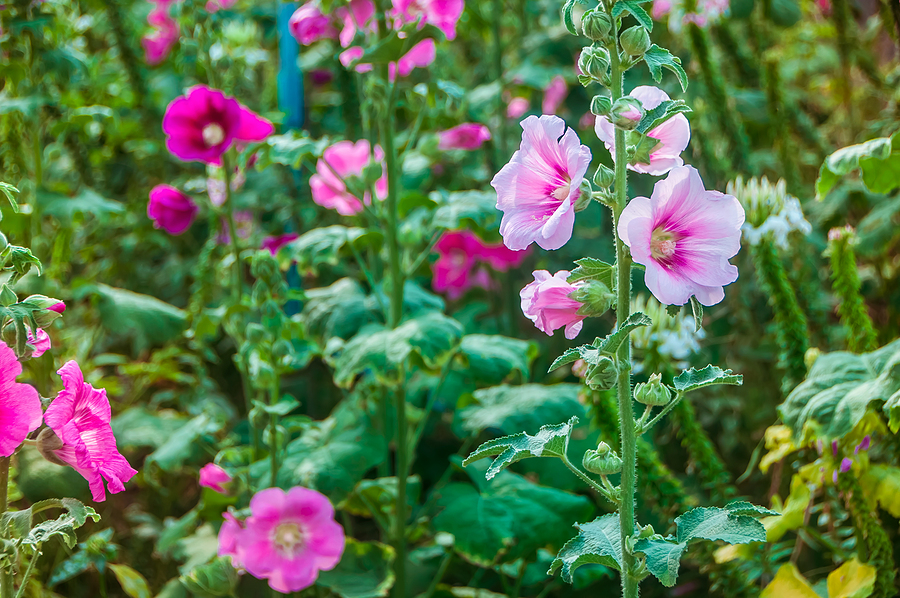
One reason I chose hollyhocks for my garden was that I grew up with them. They were in the gardens of my parents, grandparents, and many neighbors. Reaching six to eight feet in height, I still find those tall spires of large flowers impressive.
The common hollyhock (Alcea rosea) is also known as althea and rose mallow. The five overlapping petals create a bowl-shaped flower that ranges from white to pink to purplish red. The hollyhocks I bought for my garden are a cultivar with dark purples, almost black, flowers. Hollyhock has large, heart-shaped leaves with three to seven lobes. The leaves can grow up to eight inches long, but become progressively smaller toward the top of the stalk.
As with other mallows, the ancient people of China, the Middle East, and Europe used hollyhocks medicinally for a range of ailments including snakebites and scorpion stings. By the Middle Ages in Europe, these flowers were a mainstay in cottage gardens grown as much for their beauty as any practical purpose. They were regarded as the medieval commoner’s roses.
Hollyhocks were believed to provide magical protection from the devil and other perceived evils that lurked in the world. A seventeenth-century recipe listed hollyhock as an ingredient for fairy oil, which when anointed on the eyes made the usually invisible world of the fae visible. An elaborate ritual was used to gather the ingredients, which also included grass from a fairy circle. With the proper incantations, the oil was also used to conjure a fairy known as Elaby Gathon. Mothers and nannies called upon this fairy to protect babies as they slept to prevent bad fairies from substituting changelings.
In today’s magical use, growing hollyhocks in the garden attract abundance, prosperity, and happiness to a family. After moving to a new house, crumble a handful of dried flowers, and then sprinkle them around, inside and out, to help you and your family feel at home. Of course, look for fairies who may also feel at home in your garden with the hollyhocks.
If you would like to read more about fairies and plants, check out my books Magical Faery Plants and A Miscellany of Fairy Folk, Myths and Magic.