Magical Message from a Fern
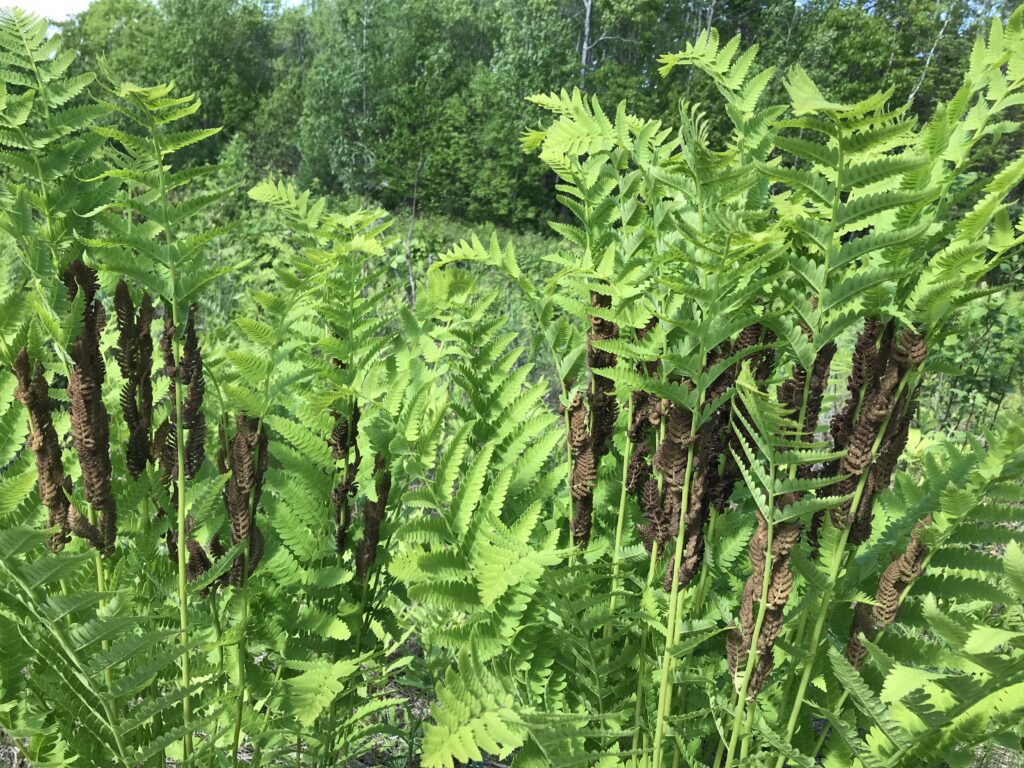
The Interrupted Fern (Osmunda claytoniana) is a bit unusual as most ferns go. The first time I saw a row of them from a distance at the edge of the meadow, I thought they looked like a line of aliens coming out of the woods. On closer inspection, I saw that they were very weird, indeed.
As it matures, this fern develops into a vase shape that reaches three to four feet tall and has fertile and sterile fronds. In the early spring, the upright fertile fronds appear first with a section near the top of the plant with brown spore-producing leaflets. After releasing the spores, these leaflets fall away leaving a gap along the stem. The sterile fronds sprout up around the fertile fronds and create the plant’s graceful shape.
Because I had never seen this plant before, I wanted to find out more about it. The species name honors Virginia botanist John Clayton (1694 – 1773) — standard stuff — but the genus proved to be far more interesting and a little obscure. Osmunda is in the Osmundaceae botanical family, which is also known as the Royal Fern family. It was given this name because the fertile leaflets, which usually appear at the top of the fronds, make the plants look like they’re wearing crowns. The species in my field, which is interrupted and not crowned, is an exception.
The origin of the genus name is not certain, but it is said to honor someone called Osmund, Osmundus, or Asmund. One story associated with it comes from Saxon mythology and tells about Osmund the Waterman of Loch Fyne on the west coast of Scotland. According to the legend, he hid his wife and daughter on a small island covered with these ferns to keep them safe during a Viking raid. His daughter is said to have named the fern after him.
Although Saint Osmund of Salisbury, England and Osmundus the Swedish archbishop of Skara are often cited as potential name sources, so too is Åsmund Kåresson. The names Osmund, Osmundus, Asmund or Åsmund have a Norse/Germanic/Icelandic origin and are composed of the word Os or Ás meaning “god” and mund, “protection.” In terms of runes, these meanings are found in the Younger Futhark symbol As, and the Anglo-Saxon Os, which are versions of the Elder Futhark Ansuz. This brings us full circle back to Åsmund Kåresson who was the earliest known rune carver in the province of Uppland, Sweden. The eleventh-century Ängby Stone is attributed to him.
Magically, like most ferns the interrupted fern is associated with protection, defense, and security. Allied with the runic interpretation of Osmund, it may suggest special protection from deities. As you might expect, this plant’s energy is an aid for runic study and readings.
After spending some time with this fern, I concluded that the interrupted feature carries a message for us all. Life will always throw curveballs that knock us off course and there are times when we need to put things on hold. Life interrupted. However, sometimes interruptions can provide a meaningful break, an interlude and chance to reassess things. Don’t be frustrated by an interruption, instead, find out what it means.
If you would like to read more about plants, magic, and runes, check out my books The Witches’ Encyclopedia of Magical Plants and Magical Symbols and Alphabets.